Resurrecting Parkinson's Cell Therapies: How AI Biotechs Can Acquire and Revitalize Discontinued Programs
Overview
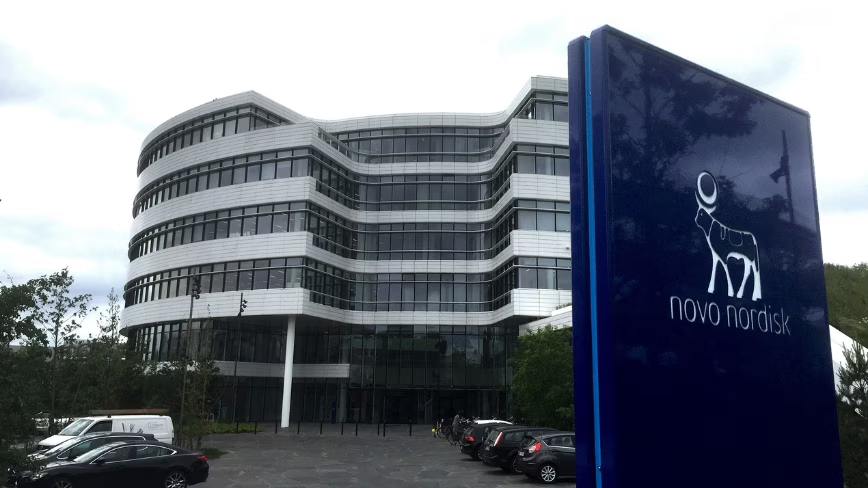
In a significant strategic move, Novo Nordisk has transferred STEM-PD — an experimental stem-cell therapy for Parkinson’s disease that it discontinued in October 2023 — to the AI-driven biotechnology startup Cellular Intelligence. This deal, which includes Novo taking an equity stake and securing milestone payments and royalties, illustrates a growing trend: large pharma companies leveraging external AI platforms to breathe new life into shelved candidates. For biotech entrepreneurs and R&D leaders, this case offers a blueprint for acquiring discontinued therapies and applying computational models to de-risk development. This guide walks through the key steps, prerequisites, and pitfalls involved in such a technology transfer and revitalization process.
Prerequisites
Before attempting to acquire and revitalize a discontinued cell therapy program, ensure your organization meets the following criteria:
- AI/ML platform capabilities — Your team must have validated models for predicting cell fate, differentiation efficiency, or patient stratification. Cellular Intelligence, for instance, uses its proprietary AI to optimize stem-cell-derived therapies.
- Regulatory and IP due diligence expertise — Understanding the original therapy’s intellectual property landscape and ongoing regulatory filings is critical. Without this, you may inherit previously unaddressed safety or compliance issues.
- Access to biological samples and data — Discontinued programs often come with stored cell lines, patient data, and preclinical results. You’ll need a biobank and bioinformatics infrastructure to analyze this information.
- Financial runway and partnership flexibility — Acquiring a shelved asset usually involves equity stakes (as Novo took in Cellular Intelligence) and milestone commitments. Ensure your investors are comfortable with risk-sharing.
- Clinical and manufacturing experience — Even with AI, cell therapy manufacturing remains complex. Partnering with a CMO or having in-house GMP capabilities is strongly advised.
Step-by-Step Guide to Acquiring and Revitalizing a Discontinued Cell Therapy Using AI
1. Identify the Right Discontinued Candidate
Search for programs that were stopped not due to fundamental safety issues, but because of poor efficacy, suboptimal biology, or strategic shifts. STEM-PD was discontinued by Novo Nordisk reportedly for the latter reasons, making it a prime candidate for AI-guided refinement. Use public databases (e.g., ClinicalTrials.gov, pharmaceutical pipeline trackers) and conference reports to spot such assets.
2. Conduct Due Diligence on the Therapy and Partner
Evaluate the original therapy’s mechanism of action (e.g., stem-cell-derived dopamine neurons for Parkinson’s), preclinical and clinical data, and manufacturing protocols. For Cellular Intelligence, this likely involved assessing the STEM-PD cell line and its differentiation protocol. Also, negotiate terms: equity stake (Novo took equity in Cellular Intelligence), milestone payments, and royalties. Both sides benefit — Novo reduces wasted R&D spend, while Cellular Intelligence gains a validated asset and cash flow.
3. Integrate AI Platform with Existing Data
Feed historical data from the discontinued program into your machine learning models. Cellular Intelligence plans to apply its AI to STEM-PD to predict better cell manufacturing conditions, identify patient subpopulations most likely to respond, or optimize dosing schedules. Ensure your data pipeline can handle heterogeneous datasets (omics, clinical, imaging). Typical steps:
- Data cleaning and harmonization — Standardize formats and handle missing values.
- Feature engineering — Extract relevant biological features (e.g., gene expression signatures, differentiation markers).
- Model training and validation — Use cross-validation to avoid overfitting. Common algorithms for cell therapy include random forests, XGBoost, or neural networks depending on dataset size.
4. Design AI-Guided Optimization Experiments
Using your platform, generate hypotheses to improve the therapy. For cell therapies, focus on:
- Cell quality and yield — AI can optimize culture conditions (media, growth factors, timing) to produce more consistent dopamine neuron batches.
- Patient selection biomarkers — Model which Parkinson’s subtypes have the highest predicted response to the therapy.
- Dose and delivery route — Simulate optimal cell numbers and injection sites based on imaging data.
Document each hypothesis and design controlled experiments in vitro or in animal models.

5. Execute Preclinical Validation with Iterative Feedback
Run the AI-generated conditions in preclinical models (e.g., 6-OHDA lesioned rats for Parkinson’s). Compare results with original study data. If outcomes improve (e.g., greater motor recovery or reduced tumorigenicity), feed these results back into the AI model to refine predictions. This closed-loop process is key to gaining confidence before clinical re-entry.
6. Prepare for Regulatory Resubmission
Engage with regulators (FDA, EMA) early to discuss your AI-derived data and proposed clinical trial designs. Highlight how AI addressed prior deficiencies. Be transparent about model limitations and validation. Cellular Intelligence will need to present a robust package showing that the therapy is now safer or more effective than when discontinued.
7. Secure Milestone Payments and Manage Royalty Streams
Structure the deal so that milestones are tied to clear achievements (e.g., successful Phase 1 completion). Novo Nordisk’s equity stake and future milestone/royalty arrangements serve as a template. Ensure your financial model accounts for these payments while maintaining sufficient cash for operations.
Common Mistakes to Avoid
- Overestimating AI’s capability — AI is a tool, not a magic wand. Without high-quality, relevant data, models will yield misleading predictions. Cellular Intelligence likely ensured STEM-PD’s dataset was sufficiently rich before committing.
- Ignoring manufacturing complexities — Even if AI improves cell quality, scaling up under GMP conditions remains challenging. Plan for process development early.
- Poor IP diligence — The original therapy may have patents that are still live or encumbered by prior agreements. Secure freedom-to-operate opinions before finalizing the transfer.
- Underestimating regulatory hurdles — Regulators may demand additional nonclinical studies if the AI-driven changes are substantial. Budget for longer timelines.
- Neglecting integration with partner culture — In a deal like Novo + Cellular Intelligence, cultural fit is important. Misaligned expectations over data sharing or decision-making can stall progress.
Summary
The transfer of Novo Nordisk's shelved STEM-PD therapy to Cellular Intelligence illustrates a powerful model for rescuing promising but stalled cell therapies. By combining a validated biologic asset with an AI platform, the startup aims to optimize manufacturing, patient selection, and dosing — potentially accelerating a new Parkinson’s treatment toward clinics. For those considering a similar path, the recipe involves careful candidate selection, thorough due diligence, iterative AI-human collaboration, and proactive regulatory engagement. This case also underscores a shift in biotech dealmaking: large pharma increasingly sees startups not just as royalty collectors, but as synergistic partners leveraging computational biology to unlock hidden value in discontinued pipelines.